3 - 11 April 2027
2370$

Meeting Place: Pokhara, Nepal


A trek along one of the quietest and most picturesque routes in the Annapurna region—from the Gurung village of Gandruk through enchanting rhododendron forests to the rarely visited Khopra Danda Ridge, where Dhaulagiri and Nilgiri rise like a wall right before your eyes. And all this amidst a carpet of flowers covering the slopes of the majestic mountains
- 1. Traveling light and affordably.The program is accessible to anyone without special training, as long as they’re in good physical shape. We’ll be doing a lot of walking (which is, after all, what a trek is all about), but we’ll travel light, leaving our luggage to the porters. On average, this will take 5–7 hours a day, leaving plenty of time to stop for tea at a local lodge, take a stroll through a picturesque village, or simply sit and gaze at the nearby white peaks.
- 2. To experience the world directly, rather than through a car window, and simply be.We spend as much time as possible outdoors on walks and hikes, in direct contact with the world around us. We explore it, touch it, taste it, breathe in its scents, and walk on it. And to make sure we have time for this, we’ve replaced complicated road trips with flights
- 3. A wider variety of experiences and mountain scenery.We’ve chosen one of the most spectacular trails that doesn’t take too long to complete, and at the height of the rhododendron bloom, we’ll head to the area surrounding the sacred Mount Machapuchare.
This is one of Nepal’s less challenging and less-traveled trails, offering unforgettable views of the Himalayan eight-thousanders. Over the course of seven days, this trek will take us through green valleys, Gurung villages, tropical forests, forests of relict rhododendrons, and blooming alpine meadows. We’ll encounter yaks and gradually ascend to an altitude of 3,600 meters. - 4. Excitement and adventure.We’ll ride in local jeeps and buses, conquer mountains and dizzying switchbacks, bathe in hot springs, and witness the most beautiful sunsets and sunrises.
- 5. An in-depth exploration of Nepal’s diverse culture.Nepal is a fascinating blend of cultures. Our trek will take us through villages inhabited by the Gurung people. When we descend to Kathmandu, we’ll encounter Tibetan culture.
- Bustling and Ancient Kathmandu
- A peaceful life on the shores of the mountain lake Feva
- Breathtaking views of snow-capped peaks, blooming, fairy-tale forests of relict rhododendrons, and alpine meadows along one of Nepal’s most spectacular treks.
- Sunrises and sunsets overlooking the iconic Himalayan peaks from an elevation of 3,600 meters
- Luxurious carpets of blooming rhododendrons on the mountain slopes
- Unforgettable panoramic view of the Great Himalayan Range with its majestic eight-thousanders.
- The most famous and revered stupa of Tibetan Buddhism in Nepal, surrounded by dozens of monasteries and the daily life of the Tibetan people
- Pashupati in Kathmandu, one of the world’s centers of Hinduism: the cremation of the deceased and the life of the sadhus
- And, of course, every day we’ll enjoy Nepali, Indian, and Tibetan cuisine, good company, and mountains, mountains, mountains—endless mountains…
Let’s go!
Spring!
The Himalayas!
A fresh start!
We’ll meet at the Pokhara airport and head into the city, where we’ll check into a quiet, cozy hotel in the Lakeside area. There, you’ll find plenty of small restaurants serving delicious and varied cuisine, fresh pastries, Nepali massages, spas, and numerous shops selling souvenirs and handmade items. For those who are short on trekking gear, there’s an entire street here lined with shops selling trekking clothing and equipment to suit every taste and budget.
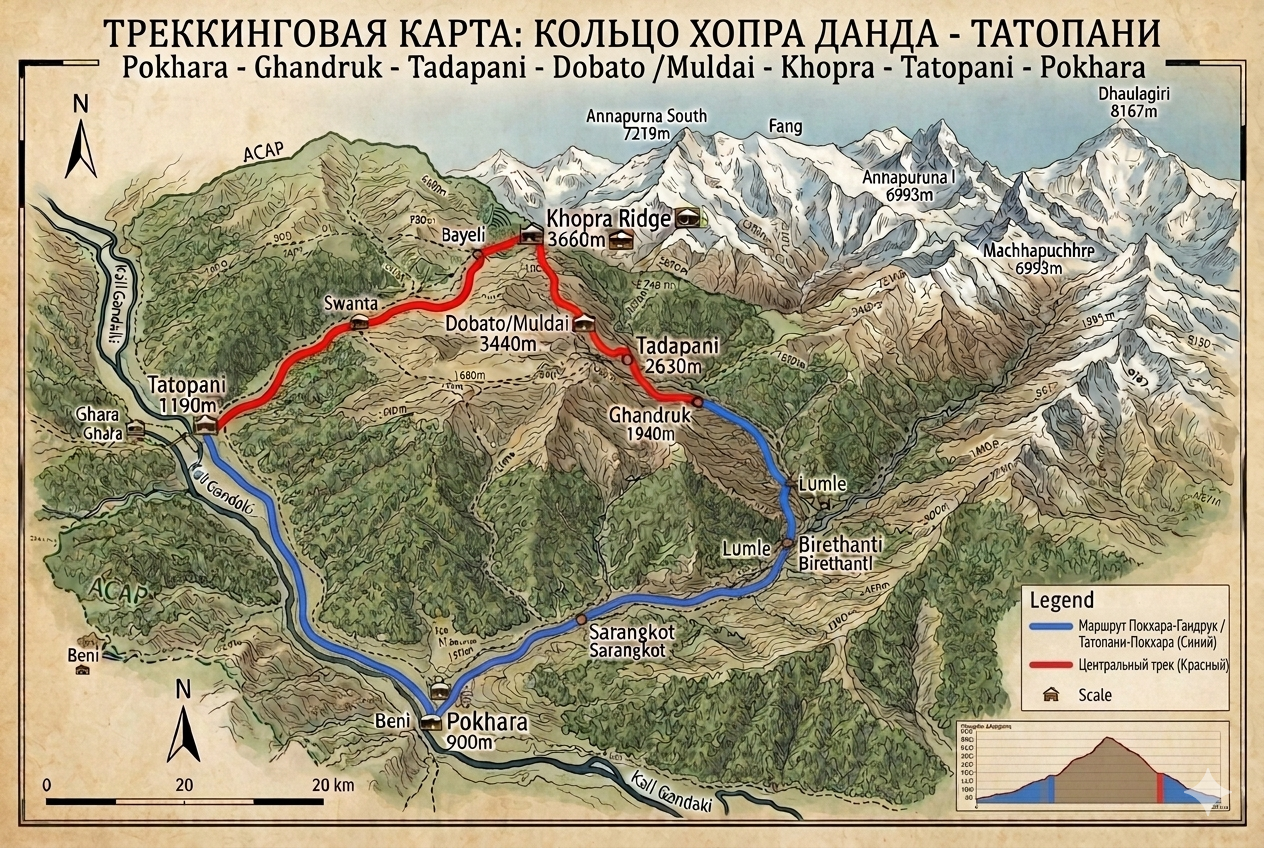
From the city straight into the mountains. Today we’ll set out on one of the most spectacular and still relatively unknown Himalayan treks in the Annapurna mountain range. In the morning, jeeps will be waiting to take us to Gandruk.
Gandruk is one of the largest and most colorful Gurung villages in the entire Annapurna region. Stone houses with slate roofs are clustered in terraces along the hillside, with old cobblestone paths winding between them, and from the open areas you can see both Annapurna South (7,219 m) and the jagged Hiunchuli.
Past the last houses of the village, the trail climbs at once — through terraced fields, past grazing water buffalo — and enters the forest. Oak gradually gives way to rhododendron, the path dips into shallow ravines and climbs back out onto ridgelines; along the way there are a couple of teahouses, good places to stop for a ginger tea and catch your breath.
Closer to Tadapani the forest turns genuinely fairy-tale-like: old rhododendron trees wrapped in moss and lichen grow so densely that light barely filters down — in spring, when they bloom crimson and pink, walking through this forest is something else entirely. The final climb is the steepest stretch of the day, but a short one.
Tadapani ("water from afar" — water genuinely used to be carried here from far away) is a tiny stop of a few lodges on a forested saddle. And it's from here, weather permitting, that you get one of the best sunset views on the whole route — of Machapuchare ("Fishtail," 6,993 m), a mountain sacred to Nepalis and officially closed to climbing: Nepalis believe it to be one of the abodes of Shiva.
Today we leave the busy trail toward Ghorepani and turn onto the far quieter Khopra direction. Few trekkers even know it exists — the trail isn't on every map, and those who have walked it tend to come back with the same look on their face.
Right past Tadapani there's a short drop into a shallow gorge, then another climb — through a dense, nearly untouched forest of rhododendron and oak, mossy and muted green, as if we'd walked straight into a "Lord of the Rings" set. Along the way there are a couple of rest stops where you can grab a dal bhat and a masala chai.
Further on the forest thins out, the terrain opens up, and the last hour and a half to two hours of the day become a serious, sustained climb that brings us onto the north side of the ridge. This is where, behind you, the panorama of Annapurna South, Hiunchuli, and Machapuchare starts to unfold — the mountains grow bigger and closer with every meter gained, and as experience shows, this is exactly where people's pace suddenly slows down.
Dobato sits right on the ridgeline, at the edge of the forest — just a couple of lodges, but arguably the best spot on the whole route for a sunrise and sunset panorama. We sleep above 3,400 meters tonight — the first genuinely high-altitude night of the trek, so we take the evening slow, listening to how our bodies are doing.
Optionally, early in the next morning you can head up light to the Muldai Top viewpoint (3,800 m, about an hour one way) — the best sunrise spot for Dhaulagiri and Annapurna, though it adds a couple of hours and roughly 300 m of extra gain and loss to the day.
This is the longest trekking day of the first part of the route — both in distance and in time on the trail — even though the net elevation gain looks modest on paper: the trail doesn't climb in a straight line but dips down and climbs back up several times through intermediate pastures.
Early risers can head out light before breakfast to the Muldai Top viewpoint (3,800 m, about 40–50 minutes one way from Dobato) — sunrise here is one of the best on the entire route: Dhaulagiri and Annapurna catch pink light before the sun even clears the horizon. After descending back to the lodge and having breakfast, the main leg of the day begins.
From Upper Chistibung begins the day's final and most striking stretch: the trail finally climbs above the treeline into alpine meadows and pastures, gaining altitude steadily all the way to the ridge. It's along this stretch that Annapurna South first appears through a gap between the slopes on your left — a sign that Khopra Danda isn't far now. The stop itself greets you with the same open ridge and panorama of Dhaulagiri, Nilgiri, and the south wall of Annapurna described earlier — but today, after a long day on the trail, that view feels especially well earned.
Khopra Danda (also called Khopra Ridge) is an open terrace on the ridge at 3,660 m, a handful of lodges, and by now a full 360-degree panorama: besides Dhaulagiri and Nilgiri, you can see the entire Annapurna South massif with Hiunchuli from here. Many who've been here consider the view even more striking than the much more famous Poon Hill — with the difference that here you watch it almost alone. You may want to get up early the next morning to watch the sunrise—the light here at that time of day is truly one of a kind.
The longest and most physically demanding day of the route — essentially a full day of descent. It starts with one last look at Dhaulagiri from the Khopra Danda terrace, after which the trail drops steeply — first through alpine meadows, then into dense, cool forest.
The first part of the descent (via Chistibang) is steep and technical, switchbacking along streams. The forest visibly changes as we go: rhododendron and oak give way to warmer, more southern vegetation — and that alone tells you how much elevation we're losing. Along the way there are small Magar villages with terraced fields, good spots to stop for lunch (usually Paudwar or Ghara).
Tatopani ("hot water" in Nepali) sits deep in the Kali Gandaki gorge at just 1,190 m — the warmest point on the whole route. And here, at the end of a long descent day, a well-earned reward awaits — natural hot springs right on the riverbank, perfect for soaking away several days' worth of trekking fatigue. The village historically sat on the old pilgrim route to Lake Manasarovar in Tibet, so this place has seen its share of travelers long before us. Evening in Tatopani is an entirely different, warm and relaxed world — strikingly unlike the high-altitude Khopra we left that same morning.
In the afternoon, if you’d like, we can hike to the summit of Sarangkot, which offers stunning views of the Great Himalayan Range and Machapuchare, a mountain we’ve already become familiar with. The mountain is home to Nepal’s most famous paragliding launch site. Those who wish can glide down in a tandem flight with a pilot and enjoy breathtaking views of the pale-blue basin of Lake Fewa, the snow-capped mountains, and Pokhara.
Believe us, one day you'll have a burning desire to come back here
Patan, an ancient satellite city of Kathmandu, greets us with a sudden change of pace. As soon as we cross the bridge over the sacred Bagmati River, the chaos of the modern capital fades away, giving way to the concentrated harmony of the past.
The heart of Patan is its Durbar Square, a visual masterpiece of Newari architecture. Here, the ground is literally paved with red brick, upon which rise multi-tiered pagodas with filigree carvings on their windows. The majestic Krishna Mandir temple, carved entirely from gray stone, contrasts with the warm terracotta walls of the royal palace. In the rays of the setting sun, the gilded spires and bronze figures of kings atop tall columns glow with a warm, almost mystical light, reflecting the grandeur of the Malla dynasty.
Kathmandu
We’ll walk around the stupa, which represents a three-dimensional mandala—a miniature universe—spin all 150 prayer wheels, and visit the most interesting monasteries in the complex.
During the evening arati, a ceremony of light and fire, we will immerse ourselves in the spiritual life of Hinduism. We’ll visit numerous temples, learn about the lives of the sadhus (ascetics and yogis who have devoted themselves entirely to achieving liberation through meditation and knowledge of God), observe cremation ceremonies, and reflect on life and death. The most daring among us can take a purifying bath in the waters of the sacred Bagmati River—a ritual that washes away all sins—or simply float oil-filled candles in leaf boats on the water.
See you soon )
For four years now, traveling has become our way of life—it has become our life! We don’t stay in one place; we’re always on the move—from Nepal, India, and the Himalayas to Myanmar and Thailand; from Mongolia to China; and from China to Chile, Bolivia, and Argentina. Amazingly, we’ve both found our calling and get a huge thrill from working as tour guides. Amazingly, we both value the same things in our travels: a subtle atmosphere of kindness, friendship, and support, and a deep connection with a country that emerges from the little details.
Our philosophy: a trip to any country can be made enjoyable and comfortable. Let there be excitement, adventure, mind-blowing new experiences, dust, and hustle and bustle—but you should always return to a cozy, clean bed. Because harsh conditions often block a person’s perception. We’re all about the gentle, gradual unfolding of each person’s experience, about lightness, and about the joy of life. We’re not about goals or conflict.
We love countries that civilization hasn’t yet reached, so we can fully savor the unspoiled beauty and uniqueness of the people and nature. That’s why Myanmar, why Mongolia, why Bolivia. We love mountains, which is why Nepal and the Indian Himalayas, why Patagonia.
We are truly happy people; somehow we manage to inspire those who come to visit us with our passion for these countries, for life, and for happiness. And often, people’s lives change dramatically—they see new opportunities, make new friends, and set changes in motion. The countries we discover are extraordinary. Travel is like a fresh start. Like being 100 percent present. Like a discovery.
The breathtaking sunrises in the Himalayas, the shimmering scales at the morning fish markets in Palawan, the surprised face of a llama amid the ruins of pre-Columbian fortresses in the Cordilleras. The world is incredibly beautiful and full of amazing details. And the joy of discovering new places and getting to know them can only be matched by the joy of sharing these discoveries.
Let’s go!
e-mail: hurma.mark@yandex.ru


- Accommodations along the entire itinerary
- Services of Russian- and English-speaking guides throughout the entire itinerary
- Transfers to and from the airport
- Admission to all monasteries, museums, and national parks included in the itinerary
- Permits for trekking in the Annapurna mountain region
- All ground transportation and travel (excluding flights)

- Airfare to Pokhara and from Kathmandu
- Flights between Pokhara and Kathmandu (total of $120)*
- Porters (approximately $24 per day for up to 20 kg; one porter can be shared between two people)
- Medical insurance
- Visa ($50, obtained upon arrival)
- Meals ($15–20 per day)
- Personal expenses (souvenirs and other items)
-
- TransportationWe’ll enjoy a scenic flight on a small Nepal Airlines plane from Pokhara to Kathmandu. We’ll travel by jeep along the winding mountain roads from Pokhara to Gandruk and from Tatopani to Pokhara,
We’ll use jeeps, planes, taxis, buses, and boats. But most importantly, we’ll do a lot of walking, take walks, and meditate on the mountains. - AccommodationsNo tents! 🙂 The charm of mountain treks in Nepal lies in the opportunity to stay in authentic villages, in local residents’ homes that have been converted into lodges with simple, basic amenities. These homes are called “lodges” here. Each lodge has its own café, where the hostess prepares both local (Nepalese or Tibetan) dishes and European, Chinese, and Italian cuisine. Or whatever she considers to be such 🙂 In Pokhara and Kathmandu, we’ll also choose quiet hotels: clean, cozy, welcoming, and with their own unique character. We also try to choose lodges and hotels with beautiful mountain views.
- FoodNepalese cuisine is similar to Indian cuisine in many ways, but it isn’t as spicy. The greatest treat is masala tea (sweet tea with milk and spices), which is served in small cups. Dal bhat is the Nepalese version of a thali: a perfectly balanced meal consisting of rice served separately, several types of stewed vegetables and herbs, a thick lentil soup, and a crispy papad flatbread. Samosas are fried, pyramid-shaped pastries filled with chickpeas, potatoes, and spices. Here, they bake chapati for breakfast—unleavened flatbreads cooked over an open fire. In the highlands, we’ll be able to try Tibetan cuisine—steamed momo dumplings filled with meat or vegetables and cheese, fried noodles, and yak cheese. But don’t expect an abundance of meat, especially in the highlands. In Pokhara and Kathmandu, you’ll find fruit, fresh coffee, delicious pastries, and homemade yogurt.
You should budget about $15–20 per day, depending on your appetite. - SafetyIn Kathmandu, especially in the Thamel area, keep an eye on your belongings to prevent pickpocketing. In the mountains, stay fully alert and always watch where you step and where you’re going. Treat Nepalese culture with respect and follow the accepted rules of conduct in monasteries and pilgrimage sites.
- VisaGreat news—you can get a visa to Nepal upon arrival. There’s no need to apply for it in advance. A 15-day visa costs $30, and a one-month visa costs $50. To obtain a visa at the airport, you’ll need to have a passport valid for at least six months, a copy of its first page, the required amount in dollars, and a visa application form, which you can fill out in English on-site or in advance on the website.
- Information SupportInformation support is an important part of our work. We are happy to share our knowledge, experience, and understanding of the country, starting from the moment we receive your application and your first call, continuing throughout your entire trip, and, if necessary, afterward.
The itinerary assumes that you will make your own way to Pokhara. In addition, before the trip, each participant must complete a series of preparatory steps:
– purchase a plane ticket
– gather the necessary documents and items
– arrange medical insurance for the entire duration of the trip
To ensure the preparatory phase goes smoothly, we will provide individual guidance on any questions you may have. We will send everyone an informational letter with all additional details—from the weather and necessary gear to a list of books and movies about the region. - TeamWe’ve planned a trip to Nepal that’s exciting, educational, and action-packed. When traveling to Nepal, it’s important to understand that this isn’t “old Europe”—it’s a wild, mountainous country. That’s why there’s a higher element of the unexpected here than anywhere else. With a certain amount of life and travel experience, you can turn almost any unexpected event to your advantage and turn it into an adventure—and that’s usually how the most memorable moments of a trip happen. But you need to be prepared for them and trust yourself, the “wonderful world,” the guides, and the people around you. That’s why for this trip, we’re not just putting together a group of participants—we’re building a real team of people who are ready for the unexpected and willing to help one another out. That’s why we’ll have a detailed conversation with each of you via WhatsApp. And as experience shows, the people who join trips like this tend to be very interesting. They often become friends and stay in touch.
hurma.mark@yandex.ru
